

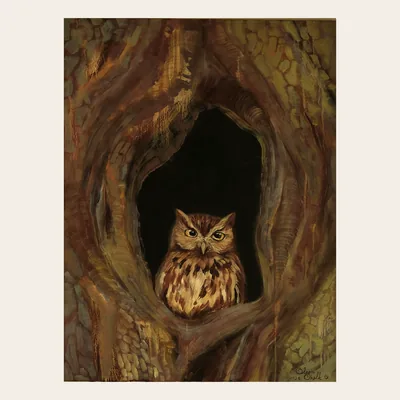
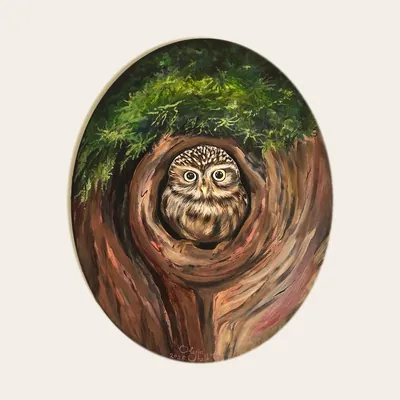
Two oil paintings by Olesia Shelkovenko show an owl looking out of a tree hollow: Keeper of Silence, 60×80 cm, and A Quiet Place, an oval canvas of 40×50 cm. Both were painted in 2026, and they are built in opposite ways. In the first the bird sits low in a tall dark opening, and you find it after the tree. In the second the bird fills the opening and looks straight at you.
This page puts the two side by side at the same scale, points out what to look at in each, and explains two things about living owls that both paintings rely on: why an owl spends the day in a hollow, and what the “ears” on its head are.
Same scale · Keeper of Silence · A Quiet Place · Why a hollow · The “ears” · In the artist’s words · Choosing
The two paintings at the same scale

Measured on these photographs, the owl in Keeper of Silence is about 20 cm wide and 24 cm tall, tufts included. The owl in A Quiet Place is about 13 cm wide and 15 cm tall. In both paintings the bird takes up roughly a third of the width of the canvas. What differs is everything around it.
Keeper of Silence: an owl at the bottom of a tall hollow


The dark opening is about 45 cm tall, more than half the height of the canvas, and the owl sits on its lower rim. Above the bird there is only black. From across a room the picture reads in this order: the bark, the dark shape of the hollow, and then the bird.
Up close, look at three things. The owl has two pointed tufts of feathers on its head. Its yellow eyes are half closed under slanted brows, so it seems to watch without moving. Its breast is pale with dark vertical streaks, in the same browns and ochres as the trunk: the bird and the tree are painted from one palette.
The bark deserves a look of its own. At the edges of the canvas it is laid in olive-green blocks; nearer the hollow it turns into long strokes that bend round the opening, with ochre drips running down them.
A Quiet Place: an owl that fills the opening

Here the hollow is round and only a little wider than the bird, about 15 cm across. The owl has a round head without tufts, a crown flecked with white, and wide-open yellow eyes ringed with pale feathers. Its feet grip the lower rim. Nothing is hidden: the pale face against the dark opening is clear from the other side of the room.
The wood is painted in warm red-browns that swirl round the opening like grain round a knot. A band of green foliage runs across the top of the oval and takes up about a third of the canvas. The signature and the year are at the bottom, in the middle.
Why an owl sits in a hollow by day
An owl that rests by day is safest when nobody sees it. The Cornell Lab of Ornithology describes how one small owl, the eastern screech-owl, sometimes spends the day in a tree cavity, sitting so that it fills the entrance, while its grey and brown feathers blend with the bark around it.1 The Owl Research Institute adds that many owls hide by standing tall and pulling their feathers in tightly, which makes them thinner and harder to see.2
Old trees matter here. The British Trust for Ornithology writes that little owls prefer places with large, old trees that have cavities suitable for nesting. It also notes that these owls are sometimes active in daylight, when they can be seen on perches in veteran trees.3
Both paintings show this situation: an old trunk, a cavity, and a bird coloured like the wood. In Keeper of Silence the match is closer, because bird and bark share one palette. In A Quiet Place the owl is lighter than the wood and stands out from it.
The “ears” are feathers
The points on the head of the owl in Keeper of Silence are not ears. They are tufts of feathers and have nothing to do with hearing: an owl’s ear openings are slits on the sides of the skull, hidden under the head feathers.2 What the tufts are for is not settled. One suggestion is camouflage, since raised tufts look like small twigs or broken branches; another is display. The Cornell Lab notes that there is no scientific consensus and that nobody has yet studied the question in detail.4
Not every owl has tufts: the bird in A Quiet Place has a smooth round head. This page does not name a species for either owl. Of the bird in Keeper of Silence, Olesia says that the species does not matter: it is simply an owl, painted as a symbol of wisdom.
In the artist’s words
Olesia describes Keeper of Silence as a painting about a tree: “the image of an old tree as a symbol of memory, endurance and inner refuge”, where “the space inside the tree becomes a metaphor for silence and safety”. Her description does not mention the owl at all. The subject is the tree and the space inside it.
About A Quiet Place she writes: “This little owl is about finding a sense of home within yourself: calm, contemplation and quiet wisdom. It does not rush anywhere; it simply watches and exists.”
Both descriptions are given in full on the paintings’ pages.
Choosing between the two
If you are choosing one of them for a study or a reading corner, start from the wall and from where you will stand or sit.
Keeper of Silence is a vertical canvas of 60×80 cm. From a few steps back you see the tree first and the owl second; up close, the eyes. It suits a wall where the whole trunk can be taken in.
A Quiet Place is an oval of 40×50 cm, about a third of the area. It fits a narrow wall or a gap between shelves, and the owl’s face stays readable from a distance.
Both are oil on canvas with painted edges, so neither needs a frame, and both are signed. Each exists once: these are originals, not prints.
The price is on each card. Shipping for your country is shown on the painting’s page before you pay; how buying works is explained in Buying and shipping.
Sources
- Cornell Lab of Ornithology, Bird Academy: Eastern Screech-Owl Camouflage.
- Owl Research Institute: Owl Adaptations.
- British Trust for Ornithology: Little Owl.
- Cornell Lab of Ornithology, Bird Academy: Everything You Need To Know About Feathers.
The sources were checked on 18 November 2026. The sizes of the owls were measured on photographs of the paintings and are approximate.
More subjects from the paintings are in the field guide.